

Want to avoid dementia? Study suggests you should hop on a bike

Prioritizing mental health during hard news cycles
LiveNOW's Carel Lajara discusses how to prioritize your mental health during difficult news cycles with psychiatrist Dr. Daniel Bober.
Cycling is not only good for the planet and your fitness. New research suggests it may also help protect the brain. A large UK Biobank analysis reports that adults who used a bike for errands and other nonwork trips had a lower risk of developing dementia than those who relied on a car, bus, or train.
The cohort, published in JAMA Network Open, tracked participants for more than a decade. Researchers found meaningful risk differences tied to travel mode, even after adjusting for age, education, lifestyle, and health conditions.
Why cycling stands out
Cycling and mixed-cycling were associated with lower rates of all-cause dementia, young-onset and late-onset dementia, and Alzheimer’s disease. Brain scans also linked cycling with greater hippocampal volume, a region central to memory and learning.
By the numbers:
Participants who reported cycling most often for recent nonwork trips had a lower dementia incidence than nonactive travelers. Mixed-walking also showed a modest reduction for all-cause dementia, though walking alone did not. In this dataset, walking was linked to a higher risk of Alzheimer’s disease, a finding the authors say needs more study.
- 479,723 participants, average age 56.5.
- Median follow-up, 13.1 years.
- 8,845 developed dementia, including 3,956 with Alzheimer’s disease.
- Cycling and mixed-cycling: hazard ratio 0.81 for all-cause dementia and 0.78 for Alzheimer’s disease versus nonactive travel.
- Stronger associations were seen in people without APOE ε4, the major genetic risk factor for Alzheimer’s.
Physical activity is a recognized lever for brain health. The 2024 Lancet Commission lists activity among 14 modifiable factors that may prevent or delay about 45% of dementia cases worldwide. Active travel is one way to build movement into daily life, and the UK Biobank offers a rare chance to connect travel habits, long-term health outcomes, and brain imaging at scale.
The other side:
This was an observational study. It cannot prove that cycling prevents dementia. Travel mode was self-reported, which can introduce errors.
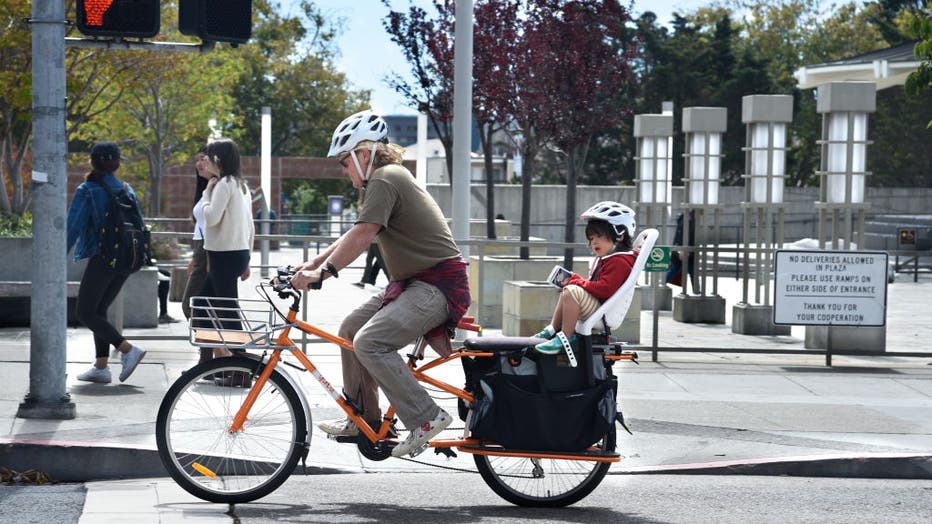
A man rides a bike with a child passenger in San Francisco. A new study suggests choosing cycling for everyday trips may help lower the risk of dementia. (Photo by Robert Alexander/Getty Images)
Most participants were of European ancestry, which may limit generalizability. The walking and Alzheimer’s signal could reflect unmeasured factors, such as intensity or health status, and needs replication.
Big picture view:
Designing streets and policies that make short trips bikeable could deliver brain health benefits alongside cleaner air and lower transportation costs. The results also hint that cognitively engaging movement, such as balancing, route finding, and reacting to traffic, may matter for the brain.
Cities and counties weighing bike lane projects, traffic-calming, or safe routes initiatives can frame these efforts as public health infrastructure. Health systems and employers can support secure bike parking, loaner programs, and education to make cycling a realistic option for everyday errands.
What's next:
Researchers say randomized trials and more diverse cohorts are needed to test cause and effect and to explore how intensity, distance, and e-bikes factor in. Repeated measures of travel over time would clarify whether changing habits later in life shifts risk.
What you can do:
If it is safe and feasible, replace short errands with a bike trip a few times a week. Pair cycling with a helmet, lights, and a predictable route. For those who cannot bike, brisk, cognitively engaging activity may offer similar benefits.
The Source: This report is based on a cohort analysis using UK Biobank data published in JAMA Network Open: "Active travel modes and risk of incident dementia and brain structure," which evaluated nearly 480,000 adults in Great Britain with brain imaging in a subset. Additional context comes from the 2024 Lancet Commission on dementia prevention, intervention, and care.