

NASA images reveal ‘once-in-a-century’ moon crater, largest recent impact discovered
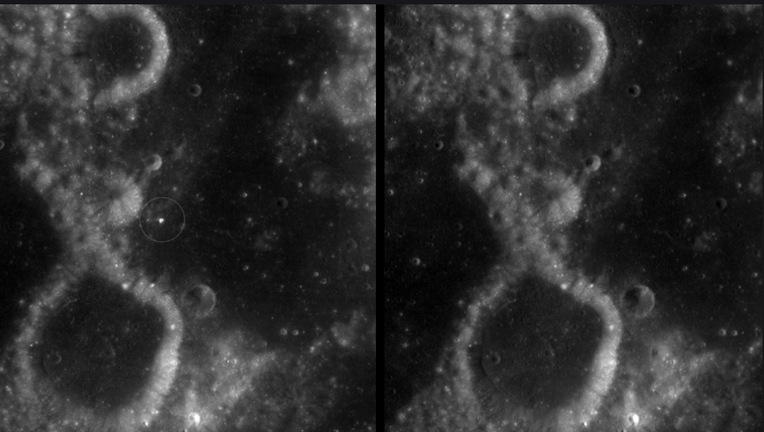
A zoomed-in view of McGetchin crater, circled on the left, next to a "before" image on the right. (Credit NASA Goddard/Intuitive Machines/Robert Wagner)
Scientists have discovered a "once-in-a-century" crater on the Moon that was created by an asteroid or comet fragment in 2024.
Dig deeper:
The crater, named McGetchin crater, measures about 222 meters across. Researchers say it is the largest recently formed impact crater found anywhere in the solar system.
The crater formed in the spring of 2024 but was not discovered until the fall of 2025. Scientists found it by comparing images of the Moon taken before and after the impact by NASA’s Lunar Reconnaissance Orbiter.
RELATED: US Space Force increasing ranks, offers service members from other branches transfer opportunity
The spacecraft photographs the entire Moon each month. By comparing images taken under similar lighting conditions, researchers can spot changes on the lunar surface.
World watches 'Blood Moon' lunar eclipse
The Planetary Society's Mat Kaplan joins LiveNOW's Anna Marsick to discuss the Thursday night 'Blood Moon' lunar eclipse.
Scientists later used higher-resolution images to study the crater. They found that it is about 43 meters deep and has a rim that rises nearly 8 meters above the surrounding ground.
The impact was much more powerful than the event that created the previous largest recently formed lunar crater, which measured about 70 meters across. Researchers estimate the McGetchin impact released about 65 billion kilojoules of energy.
Models show that an impact this large is expected to happen only once every 132 years on the Moon.
The crater formed near the boundary between two types of lunar terrain: ancient highlands and dark volcanic plains. Researchers believe the difference in the ground beneath the surface caused the crater to form unevenly.
RELATED: Mercury is shrinking faster than expected, new study suggests
The crater is not perfectly round. One side is wider than the other, possibly because the impact struck softer soil on one side and a harder layer of ancient lava on the other.
The impact also sent rocks and other material far across the Moon. Scientists found changes on the surface more than 120 kilometers away, or more than 1,000 times the crater’s radius.
Researchers believe some of the distant damage was caused by high-speed streams of material thrown out during the impact. The discovery could help scientists better understand how lunar craters form and how debris spreads across the Moon.

Images shows aftermath of rocket crashing into moon
A SpaceX rocket crashed into the moon earlier this week and now officials have released the first photograph showing the aftermath of the collision. Retired NASA astronaut Butch Wilmore joined LiveNOW's Josh Breslow to discuss that and other space headlines, including the future of the Artemis missions.
Because the Moon has no atmosphere, rain or active plate tectonics, changes caused by impacts can remain visible for long periods. Scientists say studying McGetchin crater could improve their understanding of how the Moon’s surface changes over time.
What's next:
A future rover could examine the crater up close and collect more information about the newly exposed rocks and soil.
The Source: The information in this story came from a study published in the journal Science Advances. Researchers used images and terrain data from NASA’s Lunar Reconnaissance Orbiter and Japan’s Kaguya spacecraft to study the crater’s size, depth and debris field. This story was reported from Los Angeles.