

3D motion technology transforms ACL recovery at Orlando Health

3D motion technology transforms ACL recovery
Orlando Health’s Jewett Orthopedic Institute has introduced a new 3D motion analysis system designed to make ACL recovery safer and more precise.
ORLANDO, Fla. - Orlando Health’s Jewett Orthopedic Institute has introduced a new 3D motion analysis system designed to make ACL recovery safer and more precise.
The technology uses detailed motion tracking to give doctors objective data on how well patients are moving, helping determine exactly when it’s safe to return to play.
What we know:
The technology captures athletes’ movements in real time and provides data-driven insights to help doctors and therapists determine when a patient is truly ready to return to sport.
By focusing on measurable biomechanics rather than subjective assessments, the system helps reduce the risk of re-injury and gives patients more confidence in their recovery.
The backstory:
The technology is part of a newly developed "return-to-sport" protocol created through collaboration between Orlando Health’s sports medicine physicians and rehabilitation team.
Before this innovation, decisions about when an athlete could safely resume play often relied heavily on manual observation and patient feedback.
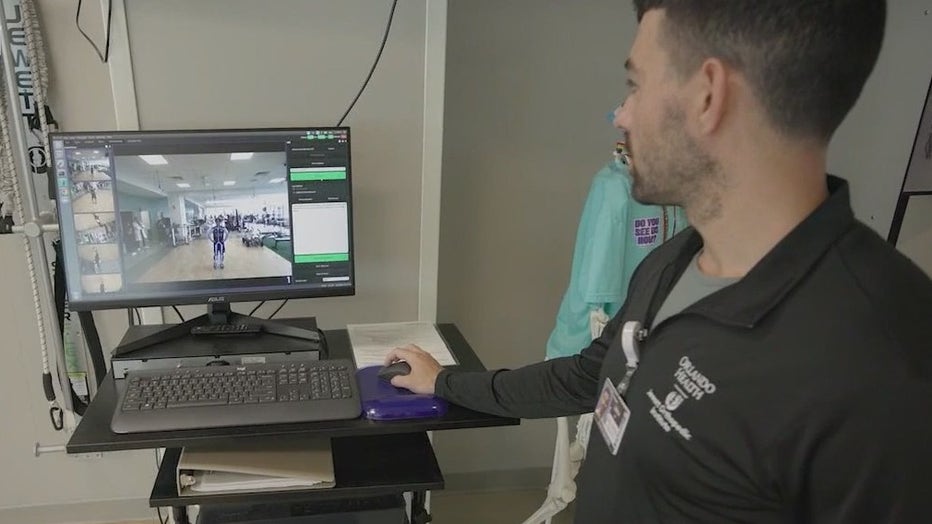
Orlando Health is using 3D motion tracking to guide ACL rehabilitation.
Now, 3D motion capture allows clinicians to slow down and analyze each step, jump, and pivot—catching subtle asymmetries that might otherwise go unnoticed.
CLICK TO DOWNLOAD THE FOX LOCAL APP
Fabricio Mendez Diaz, a 15-year-old soccer player from Kissimmee, recently went through the return-to-sport testing after undergoing ACL surgery with Dr. Carbone.
Timeline:
Over the past year, Orlando Health has integrated this motion analysis system into its rehabilitation process at the Downtown Complex.
Patients recovering from ACL reconstruction undergo periodic motion scans, which are reviewed by both physical therapists and surgeons to assess readiness for sport.
What they're saying:
The system is now a standard part of post-ACL surgery care for young athletes across Central Florida.
"We’re able to capture the movement live and then look on the software, slow that down and see how somebody is moving," said physical therapist Simon Brossier, PT, DPT. "One of the common things we see is an avoidance pattern, where a patient is shifting away from their surgical side."
SIGN-UP FOR FOX 35'S BREAKING NEWS, DAILY NEWS NEWSLETTERS
Soccer player Fabricio Mendez Diaz, 15, said the experience transformed his recovery.
"I feel amazing," Diaz said. "No doubts, back on the field without thinking I’m going to tear my ACL again."
Orthopedic surgeon Dr. Andrew Carbone added, "The graft itself takes a while to heal, and sometimes we feel a lot better than our knee actually is. Initially, we did scan Fabricio, and he had a little bit of quadricep weakness. We know that’s a significant risk factor for return-to-play and re-tearing his ACL, so we sent him back to therapy to work on that."
The Source: This story was written based on information shared by Orlando Health’s Jewett Orthopedic Institute.