

Monkey spotted near Mount Dora's Lakeside Inn as sightings continue across Central Florida
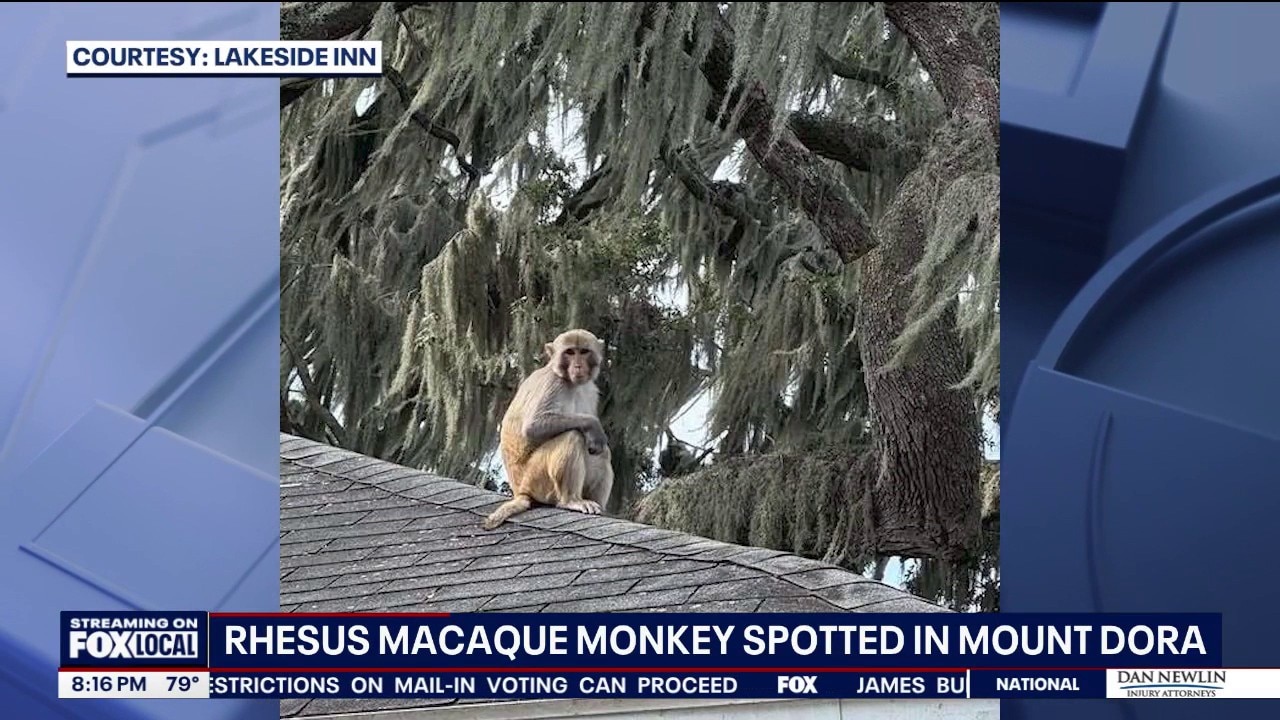
Monkey spotted near Mount Dora's Lakeside Inn
A monkey believed to be a rhesus macaque was spotted in Mount Dora, marking the latest reported sighting of the non-native primates in Central Florida. The animal was first seen near Gilbert Park before later appearing on the grounds of the historic Lakeside Inn, according to witnesses.
MOUNT DORA, Fla. - A monkey believed to be a rhesus macaque was spotted in Mount Dora, marking the latest reported sighting of the non-native primates in Central Florida.
The animal was first seen near Gilbert Park before later appearing on the grounds of the historic Lakeside Inn, according to witnesses.
In a social media post, the inn said staff immediately contacted wildlife authorities after spotting the monkey.
"Before anyone asks, no, he’s not joining our hospitality team," the inn wrote. Officials said wildlife specialists responded, but the monkey had left the property before they arrived.
"At this time, he is no longer on the property," the inn said.
Established rhesus macaques populations in Florida
Local perspective:
Monkeys are not native to Florida and are considered invasive when they establish populations that harm native plants, animals, ecosystems or people.
Researchers at the University of Florida have documented five monkey species in the state, with three having established breeding populations: rhesus macaques, squirrel monkeys and vervet monkeys.
The Florida Fish and Wildlife Conservation Commission prohibits feeding wild monkeys and encourages residents to report sightings.
Where did these rhesus macaques come from?
Dig deeper:
According to University of Florida researchers, the first documented introduction of monkeys in Florida occurred in the 1930s along the Silver River in what is now Silver Springs State Park.
A commercial riverboat captain known as Colonel Tooey released about six rhesus macaques on an island in the river in an effort to attract tourists. Local folklore has linked the release to the filming of the 1939 movie "Tarzan Finds a Son," but researchers say the monkeys were already present before production began.
CLICK TO DOWNLOAD THE FOX LOCAL APP
Because rhesus macaques are strong swimmers, they eventually reached the surrounding forest and established a breeding population, wildlife officials say.
Researchers estimated there were about 175 rhesus macaques living in five groups at Silver Springs State Park in 2015. A 2018 study found at least 134 macaques in six groups along the Ocklawaha River.
Current estimates place Florida’s rhesus macaque population in the hundreds, with researchers suggesting there may be between 300 and 600 animals statewide.
Do rhesus macaques pose any risk to humans?
Since the 1970s, macaques from the Silver River population have expanded into areas along the Ocklawaha River and farther south into Lake, Orange and Volusia counties.
As the population has grown, encounters with residents and tourists have become more common, raising concerns about public safety and impacts on natural resources.
Researchers say rhesus macaques at Silver Springs have tested positive for Herpes B virus, which is generally asymptomatic in monkeys but can be transmitted through bodily fluids, including bites and scratches.
The risk of transmission to humans remains uncertain, and there have been no reported cases of other wildlife species contracting the virus from macaques.
About rhesus macaques
Rhesus macaques have one of the largest native ranges of any nonhuman primate, extending from Afghanistan to the Pacific coast of China.
They primarily eat plants but also consume bird eggs, insects, honeycombs and small vertebrates.
SIGN-UP FOR FOX 35'S BREAKING NEWS, DAILY NEWS NEWSLETTERS
The monkeys live in social groups typically led by a dominant male. Females remain with their birth groups for life, while males usually leave after reaching sexual maturity and either live alone, join bachelor groups or move into other established troops.
Females generally give birth to one infant each year, though twins occasionally occur.
How to report a monkey sighting
What you can do:
Members of the public can report sightings of wild monkeys to IveGot1.org, which assists staff in tracking sightings and distribution of nonnative species in Florida. Members of the public can report monkeys approaching people and acting aggressively to the FWC’s Wildlife Alert Hotline at 888-404-FWCC (3922).
The Source: This story was written based on information shared by the Lakeside Inn, the Florida Fish and Wildlife Conservation Commission, the University of Florida, and the U.S. Centers for Disease Control and Prevention.