

Northern Lights in Florida: Where to see them, best time to look up, how to take photos

Northern Lights in Florida: Will you be able to see them?
Nearly all of the United States has a chance to again see the Northern Lights on Wednesday night, even here in parts of Florida. FOX 35's Noah Bergren explains what the Northern Lights are, why they form, where you may be able to see them in Florida, and how to best capture them on your phone.
ORLANDO, Fla. - Central Florida residents were treated to a rare light show Tuesday night as the aurora borealis, or Northern Lights, lit up skies from Sanford to Satellite Beach.
Viewers reported bright colors visible even from I-4, with the most vivid displays seen in darker areas near Mount Dora, Wekiva, and St. Cloud.
Another show for Wednesday night?
What To Expect:
Experts say another round of activity could be visible Wednesday night as a strong solar storm continues to impact Earth’s atmosphere.
Photos captured from across the region showed red, pink and purple hues glowing over the water and city skylines.
Meteorologists say the aurora forms when charged solar particles collide with Earth’s magnetic field, a phenomenon more common during this period of heightened solar activity.


Viewers are encouraged to head away from city lights and allow their eyes to adjust for the best chance to catch the display.
CLICK TO DOWNLOAD THE FOX LOCAL APP
The U.S. National Oceanic and Atmospheric Administration Space Weather Prediction Center reported that another series of coronal mass ejections (CMEs) was expected to arrive at Earth Wednesday and into Thursday morning, producing severe-to-extreme geomagnetic storms.
What is a geomagnetic storm?
For most people, a Geomagnetic Storm Watch is not something to be concerned about. The watches help government agencies, power providers, telecommunication companies, and satellite operators prepare to protect systems impacted by space weather.
Geomagnetic storms can produce stronger aurora borealis, or Northern Lights, which normally occur at the poles. However, space weather can cause the lights to expand into the northern edge of the U.S.
Geomagnetic storms could become more frequent over the next year as the sun moves into the solar maximum phase of its 11-year cycle.
A solar cycle is a sequence the sun’s magnetic field goes through every 11 years, where the field flips.
The SWPC said that some communications, GPS, power grids, and satellite navigation could be interrupted due to space weather, and critical infrastructure operators have been notified.
This is considered a rare event. Only a few G4 storms have occurred since 2019; the last "Extreme"—or G5—event happened in October 2003. The SWPC said that one resulted in power outages in Sweden and damaged transformers in South Africa.
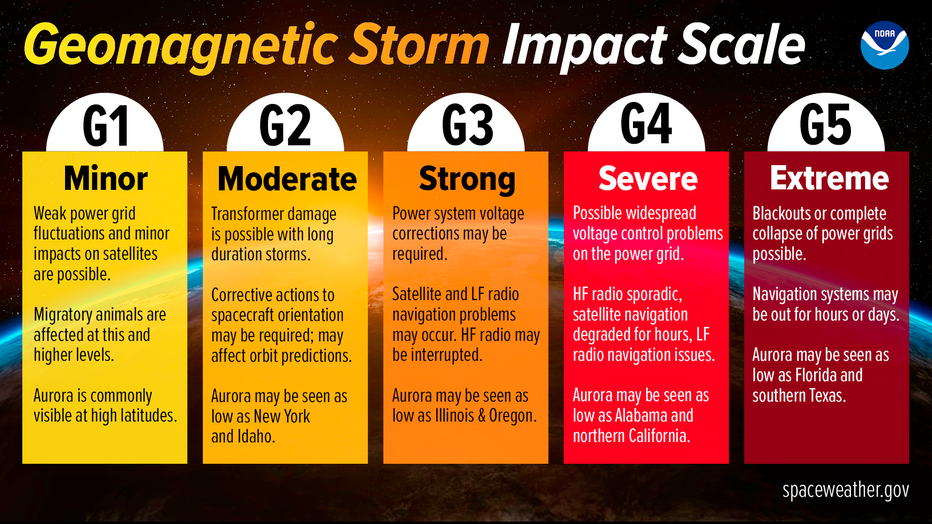
"Normally, you have to be pretty far north or south to see it because that is where Earth’s magnetic field directs the energy. But when the sun sends a big blast of particles toward us, the geomagnetic storm can be so strong that it shakes the magnetic field across much lower latitudes," said FOX 35 Storm Team Meteorologist Brooks Garner. ‘’A G4 storm is a serious one, powerful enough to push that glowing auroral oval deep into the United States."

Photos: Northern Lights around Central Florida | Nov. 11-13, 2025
Local perspective:
Brilliant red, pink, and purple hues of the Northern Lights were reported across Florida last night and captured by FOX 35 viewers.
When and how to see the Northern Lights
What you can do:
The best time to see the Northern Lights across Central Florida will be from 10 p.m. to 4 a.m.

SIGN-UP FOR FOX 35'S BREAKING NEWS, DAILY NEWS NEWSLETTERS

According to the SWPC, there are four factors to remember when looking to view the Northern Lights:
- Geomagnetic activity — this determines how bright (or not) the Northern Lights will be, as well as how they'll look across the sky.
- Location: It is best to be closest to the northern or southern magnetic poles.
- Darkness — ensure you're away from city lights to see the night sky the best. A full moon will also diminish how bright the Northern Lights look in the sky.
- Timing: the best auroras can be seen within an hour or two before or after midnight. The best times to see the Northern Lights are during the spring and fall equinoxes.
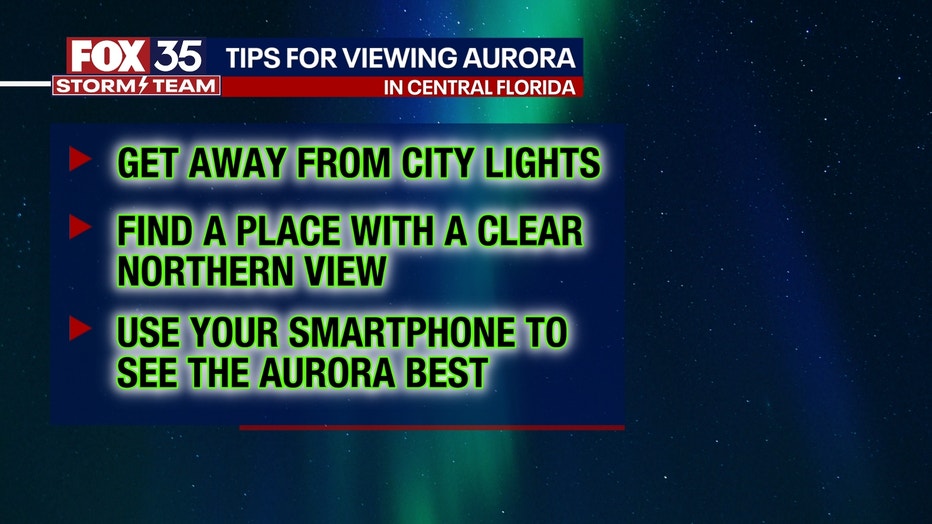
Experts recommend that if you have a smartphone, you should consider using night mode and adjusting your exposure time to around 10 –15 seconds to capture the aurora's dance.
Other helpful tips are offered by the blog site Hello Aurora below.
How to capture the Northern Lights on a smartphone
If you don't have a fancy camera, the blog Hello Aurora says you can still "record impressive videos under the right conditions" using an iPhone or Android. To do so, Hello Aurora recommends the following steps:
Step 1: Open your camera app and switch to photo mode
Hello Aurora says the aurora is more visible in your camera's photo mode than in video mode due to the longer exposure time used to capture a photo.
Step 2: Record your screen using the screen recording feature of your phone
Step 3: Edit
To get the best video possible, Hello Aurora recommends editing your recorded video by removing the initial segment where you activated the screen recording and cropping the screen as you like.
When using Photo mode, Hello Aurora says this "minimizes camera shake and makes sharper images" but does vary depending on your phone model and software version. If your phone's camera quality is not clear enough to see the Northern Lights, the blog recommends downloading an external app like NightCap, to help improve visibility.
The Source: This story was written based on information shared by the U.S. National Oceanic and Atmospheric Administration Space Weather Prediction Center, blog site Hello Aurora, and the FOX 35 Storm Team.